Menu

Menu
Safeguarding
Designated Safeguarding Lead (DSL)
Mr Ben Rix | safeguarding@fidelis.org.uk | Emergency contact: 0795 588 8845
Local Authority Designated Officer (LADO)
LADO@croydon.gov.uk or calling 020 8726 6000 (ext. 24817)
Chair of Governors
Ms Ita Murphy | chair@fidelis.org.uk | 0208 185 7770
Safeguarding Information
At Fidelis College, safeguarding is at the heart of our Catholic mission and our responsibility for the care and formation of every student.
We recognise and the dignity of every human person as the foundation of our approach to safeguarding. We seek to create a culture of informed vigilance in which every student is known, listened to, valued and protected, and in which concerns are identified and acted upon promptly.
Safeguarding is everyone’s responsibility. All members of staff, trustees, volunteers and those working on behalf of the College share a responsibility to safeguard and promote the welfare of children and young people.
Our approach reflects our College values of being Joyful, Courageous and Responsible and our commitment to In gaudio serviamus — Joyfully we serve.
What safeguarding means
Safeguarding and promoting the welfare of children includes:
-
providing help and support as soon as problems or concerns emerge;
-
protecting children from maltreatment, whether within or outside the home, including online;
-
preventing impairment of children’s mental and physical health or development;
-
ensuring that children grow up in circumstances consistent with safe and effective care; and
-
taking action to enable children to achieve the best possible outcomes.
Child protection forms part of safeguarding and refers specifically to the action taken to protect children who are suffering, or are likely to suffer, significant harm.
Our safeguarding culture
At Fidelis College we maintain an attitude that “it could happen here”.
We expect all adults working within the College to exercise professional curiosity, notice changes in behaviour or circumstances, listen carefully to students and act whenever they have a concern.
Our safeguarding arrangements include:
-
a trained Designated Safeguarding Lead and team of Deputy Designated Safeguarding Leads;
-
safeguarding and child protection training for all staff;
-
clear procedures for reporting and recording concerns;
-
early identification of children who may need help or additional support;
-
effective liaison with children’s social care, the police and other safeguarding partners;
-
safer recruitment and appropriate checks on adults working with children;
-
robust arrangements for dealing with allegations and low-level concerns about adults;
-
clear procedures for responding to child-on-child abuse;
-
appropriate filtering and monitoring of College technology;
-
education about online safety, healthy relationships, consent and personal safety;
-
close monitoring of attendance and unexplained or persistent absence as a potential safeguarding concern; and
-
additional vigilance where a student may face barriers to recognising or reporting abuse, including students with SEND, health needs or English as an additional language.
Safeguarding extends beyond the College site. We recognise that children may experience harm at home, in the community, at College or online.
The Safeguarding Team
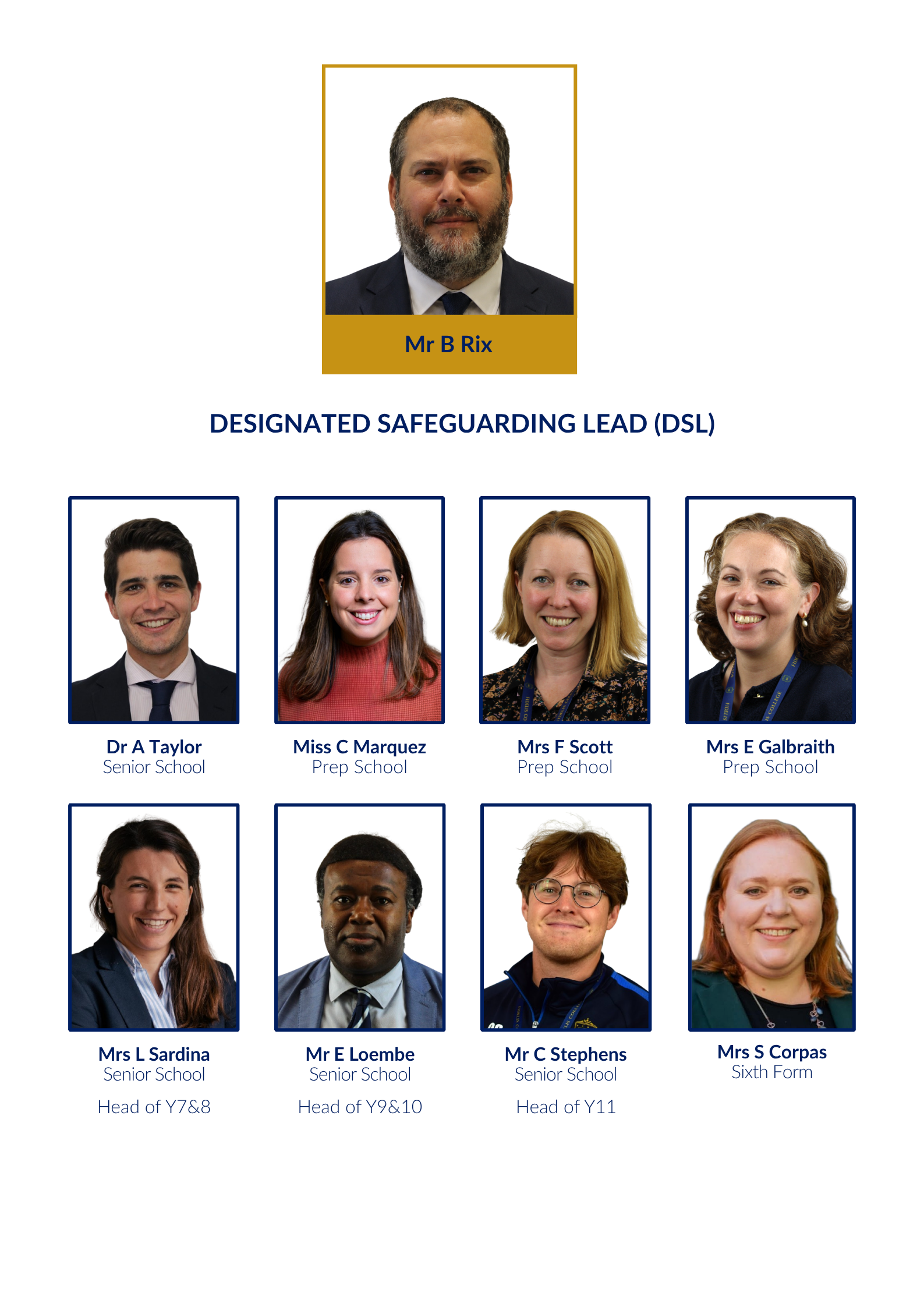
Designated Safeguarding Lead (DSL)
Mr Ben Rix
Email: brix@fidelis.org.uk
Safeguarding email: dsl@fidelis.org.uk
Emergency safeguarding telephone: 07955 888 845
Deputy Designated Safeguarding Leads
-
Miss Candela Marquez
-
Dr Andy Taylor
-
Mrs Laura Sardina
-
Mr Callum Stephens
-
Mr Evrard Loembe
-
Mrs Sophia Corpas
-
Mrs Elizabeth Gailbraith
-
Mrs Francesca Scott
The Designated Safeguarding Lead has responsibility for safeguarding and child protection across the College, including online safety and the College’s filtering and monitoring arrangements.
There is always appropriate safeguarding cover during the College day.
If you are worried about a child
If you are concerned about the safety or welfare of a student, please tell us.
Students may speak to any member of staff they trust. They do not need to decide whether something is a safeguarding matter before telling an adult. If something worries them, makes them feel uncomfortable or unsafe, or has happened to them or someone else, we want them to tell us.
Parents should contact the Designated Safeguarding Lead or a member of the Safeguarding Team if they have a safeguarding concern.
Staff, volunteers and visitors must report safeguarding concerns immediately in accordance with the College’s Safeguarding and Child Protection Policy.
A concern should never be left because someone believes that another person may already have reported it.
If a child is in immediate danger, contact the emergency services.
For an urgent safeguarding concern outside College hours, parents should contact children’s social care in the local authority in which the child lives or the police where appropriate.
Listening to students
We want every student at Fidelis College to know that there is an adult to whom they can speak.
When a student raises a concern, we will:
-
listen carefully;
-
take the concern seriously;
-
reassure the student that they have done the right thing by speaking;
-
avoid making promises of confidentiality that we cannot keep;
-
explain, as far as possible, what will happen next; and
-
take appropriate action to keep the student and others safe.
A student does not have to make a formal disclosure for an adult to act. Staff are expected to remain professionally curious and to respond when behaviour, attendance, presentation or other information suggests that something may be wrong.
Child-on-child abuse
Fidelis College recognises that children can abuse other children.
Child-on-child abuse is never acceptable and will not be dismissed as “banter”, “just having a laugh” or an inevitable part of growing up.
This includes, but is not limited to:
-
bullying and cyberbullying;
-
physical abuse;
-
sexual violence and sexual harassment;
-
harmful sexual behaviour;
-
upskirting;
-
abuse within intimate personal relationships between children;
-
sharing nude or semi-nude images;
-
coercion or exploitation;
-
initiation or hazing-type behaviour; and
-
prejudice-based or discriminatory abuse.
Students are encouraged to report concerns whether they have experienced something themselves, witnessed it or are worried about another student.
The College will support all children involved while taking proportionate safeguarding and disciplinary action where required.
Online safety
Technology is an important part of students’ lives and education, but it can also create safeguarding risks.
The College seeks to protect students from risks relating to content, contact, conduct and commerce online. This includes inappropriate or harmful material, grooming and exploitation, online bullying, sexual imagery, radicalisation, misinformation, financial scams and other emerging online harms.
The College maintains appropriate filtering and monitoring arrangements and reviews their effectiveness as part of its safeguarding responsibilities.
Online safety is taught through the curriculum and reinforced through pastoral education, relationships and sex education, assemblies and wider College life.
Students are taught how to recognise unsafe behaviour, protect personal information, seek help and report concerns.
Attendance and safeguarding
Regular attendance is an important part of safeguarding.
Repeated or unexplained absence, persistent absence, missing education or sudden changes in attendance may indicate that a child requires additional help or protection.
The College therefore considers attendance information alongside other safeguarding and pastoral information and acts promptly where patterns give cause for concern.
Students who may be particularly vulnerable
Some children may face additional risks or barriers to recognising or reporting abuse.
The College gives particular consideration to students who may:
-
have SEND or a health condition;
-
have English as an additional language;
-
be a young carer;
-
have a social worker;
-
be looked after or previously looked after;
-
experience discrimination;
-
experience difficulties within their family;
-
be affected by domestic abuse;
-
be at risk of exploitation, trafficking or serious violence;
-
be at risk of radicalisation;
-
have a parent in custody;
-
be missing from education or persistently absent; or
-
otherwise experience circumstances that increase their vulnerability.
Additional needs never lessen a child’s entitlement to protection.
Concerns about an adult
Fidelis College has clear procedures for responding to concerns about the conduct of adults working with children.
Any concern about a member of staff, volunteer, contractor or other adult working at the College must be reported promptly, however small it may appear.
Concerns about a member of staff should normally be reported to the Head of College.
Concerns about the Head of College should be reported to the Chair of the Board of Trustees.
Where there is a conflict of interest or it would not be appropriate to make the report internally, concerns may be raised directly with the relevant Local Authority Designated Officer (LADO).
The College also operates procedures for recording and responding to low-level concerns so that appropriate professional boundaries and a strong safeguarding culture are maintained.
Working with parents and safeguarding partners
Safeguarding children is most effective when the College, families and external agencies work together.
Where appropriate, we will work openly with parents when concerns arise. There may, however, be circumstances in which information must be shared or action taken without first obtaining parental consent where this is necessary to protect a child.
The College works with the local authority, children’s social care, police, health services, the Local Authority Designated Officer and other safeguarding partners as appropriate.
Information will be shared lawfully and proportionately where this is necessary to safeguard a child. Concerns about data protection must never prevent appropriate safeguarding action.
Catholic safeguarding
Our safeguarding responsibilities are inseparable from our Catholic identity.
The dignity of each human person requires us to create a community in which children are safe from abuse, exploitation, discrimination, harassment and neglect and in which they know that they will be heard.
The College works within the principles and expectations of the Catholic Safeguarding Standards Agency (CSSA) and regards safeguarding as part of our mission and ministry, not simply as a matter of regulatory compliance.
Through vigilance, compassion, courage and responsible action, we seek to ensure that every student entrusted to our care is able to flourish.
Safeguarding policies
Our safeguarding arrangements are supported by a range of College policies and procedures, including:
-
Safeguarding and Child Protection Policy
-
Staff Code of Conduct
-
Allegations Against Staff Policy
-
Low-Level Concerns procedures
-
Safer Recruitment Policy
-
Online Safety Policy
-
Acceptable Use Policy
-
Behaviour Policy
-
Anti-Bullying Policy
-
Attendance Policy
-
Children Missing Education procedures
-
Relationships, Sex and Health Education Policy
-
SEND Policy
-
Mental Health and Wellbeing Policy
-
Whistleblowing Policy
-
Educational Visits Policy
-
Health and Safety Policy
-
First Aid Policy
The Safeguarding and Child Protection Policy is available from the College website and may also be requested from the College.
Safeguarding contact: dsl@fidelis.org.uk
Designated Safeguarding Lead: Mr Ben Rix
Emergency safeguarding telephone: 07955 888 845
Safeguarding Staff